- Senior leaders from the defence, intelligence, border security and critical infrastructure sectors convened at Intersec 2026
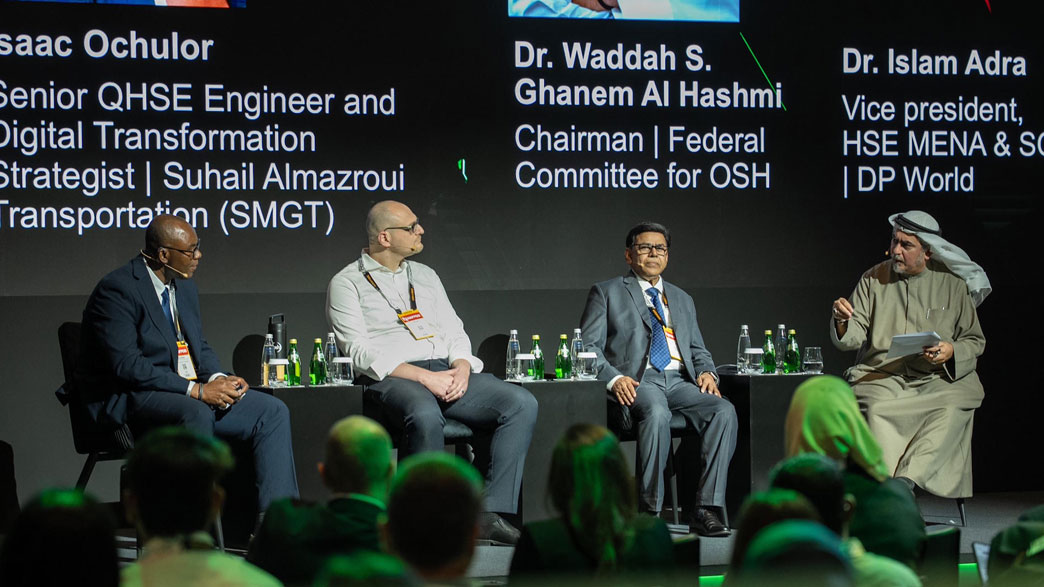
- They held a closed-door strategic roundtable examining how Gulf states can strengthen maritime border security
- Participants agreed that maritime borders sit at the intersection of sovereignty, economic continuity, and humanitarian responsibility
Hosted by global management consulting firm Kearney, in partnership with Intersec, the session titled ‘Governing the Blue: Intelligence-Led Security for Gulf Maritime Boundaries’ brought together operational commanders, policymakers and technology leaders to align governance models, intelligence structures and digital capabilities for the region’s increasingly complex maritime domain.
Participants agreed that maritime borders sit at the intersection of sovereignty, economic continuity, and humanitarian responsibility.
With the Gulf’s ports, special economic zones and energy corridors under growing strain, the roundtable highlighted a decisive shift away from reactive security postures towards intelligence-led operations that actively guide both collection and action.
Ankit Gandhi, Partner at Kearney Middle East & Africa – Aerospace, Defense and Security Practice, who moderated the discussion, said: “Across the Gulf, maritime security challenges are no longer episodic – they are continuous and converging. The strongest takeaway from this session is that intelligence only creates impact when it is institutionally embedded, operationally trusted and digitally connected.”
The discussion also underscored that humanitarian response and maritime migration must be treated as operational realities rather than procedural afterthoughts.
Participants noted that safeguarding failures frequently occur at inter-agency handover points, reinforcing the importance of clear authority, shared risk pathways and end-to-end ownership across maritime operations.
From a technology perspective, delegates discussed anchoring technology investment to clearly defined operational KPIs, alongside emerging trends in the deployment of space-based and open-source intelligence capabilities.
Secure communications and a standardised data fabric were identified as critical enablers for lawful, auditable information sharing across national and regional stakeholders.
“Technology adds value only when it is aligned to decision rights. In a hybrid threat environment, technology capabilities cannot be developed in siloes and cyber resilience is ultimately an organisational design challenge, not just a technical one,” added Gandhi.
Insights from the roundtable will now be developed into a comprehensive white paper to be published by Kearney and released imminently.
The paper will outline a capability framework for intelligence-led maritime security tailored to the operational realities of the Gulf, supporting policymakers and operators as they modernise maritime governance and command models.
Dishan Isaac, Show Director of Intersec at Messe Frankfurt Middle East, said: “Maritime security is a strategic priority for the region, and it demands frank, senior-level discussion that goes beyond technology showcases.”
“Intersec provides a neutral platform where government, industry and international experts can align on governance, leadership and operating models. These closed-door roundtables are where real progress begins, and where ideas are shaped into frameworks that can be implemented across the region.”