


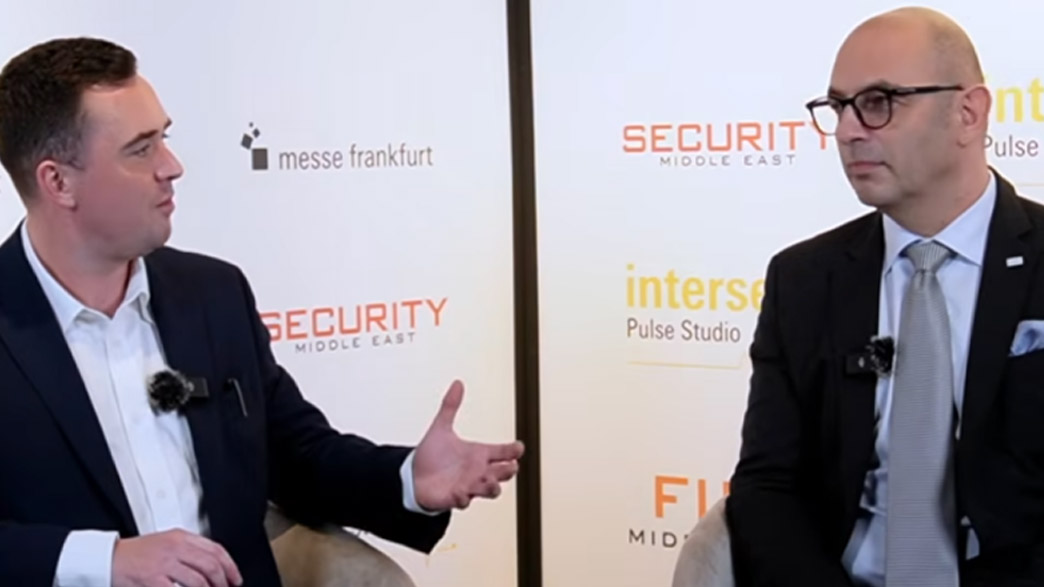
These latest sessions feature Geoff Warr of CTF, Leo Levit of ONVIF and Carsten Hoersch of ELATEC, each offering a sharp preview of the themes shaping the security sector in 2026.
The Pulse Studio format is built around concise, expert-led interviews that turn show-floor discussion into accessible insight. These three conversations continue that approach, with each guest tackling a different part of the security ecosystem, from control room design and interoperability to standards, cloud security and access control.
In conversation with Geoff Warr
Geoff Warr’s conversation with Security Middle East focuses on one of the less visible but most crucial parts of the security ecosystem: control room furniture. He explained how CTF was founded out of frustration with long lead times and the need for a faster, more locally responsive solution. That origin story sets the tone for a discussion that is as much about practical problem-solving as it is about product design.
He shared what really differentiates CTF in a crowded market, highlighting speed, responsiveness and local presence, but also made clear that the company’s advantage lies in its ability to manufacture in-house and keep quality tightly controlled. For customers working to demanding project timelines, that combination can be the difference between delays and delivery.
The conversation also gives viewers a glimpse of where control room design is heading. Warr touched on ergonomics, operator wellbeing and the way AI is changing the role of the control room itself, creating a stronger focus on comfort, performance and human factors.
In conversation with Leo Levit
Leo Levit’s session turns to a subject that is becoming increasingly central to the security conversation: how to protect investment as systems move deeper into the cloud. He discussed the risks of vendor lock-in and why standards remain essential if organisations want security platforms that can grow and adapt over time.
The interview also explored the close relationship between cloud adoption and cybersecurity. Levit explained that as technology evolves, security expectations rise with it, and that standards bodies have a role to play in supporting cyber-secure approaches and more resilient interoperability. He also referenced ONVIF’s move toward newer profiles, hinting at the pace at which the organisation is adapting to current best practice.
Beyond the technical detail, Levit gave a useful sense of ONVIF’s role in the Middle East and why the region matters to the organisation. He talked about membership, engagement and the importance of supporting a growing market that is investing heavily in the future of digital security. He finished by looking ahead to themes such as AI, cloud connectivity, media authenticity and network audio.
In conversation with Carsten Hoersch
Carsten Hoersch offered a concise but thought-provoking look at where access control is headed in the Middle East. He discussed ELATEC’s focus on open standards and open credentials, making the case that customers should not be trapped inside proprietary ecosystems if they want systems that are scalable and future-ready.
The conversation then moved into the practical realities facing organisations today. Hoersch outlined how ELATEC helps customers bridge old and new technologies, supporting migration from legacy card systems to mobile credentials while also meeting regional compliance requirements. He also pointed to the challenge of data hosting, particularly in markets such as the UAE, Saudi Arabia and Qatar, where local hosting expectations are increasingly shaping technology choices.
What makes the interview especially useful is the way it broadens the idea of access control beyond simply opening doors. Hoersch described a more unified approach, where the same credential can be used across multiple RFID applications and deliver greater value across the enterprise.
Find the Intersec Dubai Pulse Studio recorded interviews at www.securitymiddleeastmag.com.


