
AI is changing the way organisations operate, but it is also changing the assumptions on which cybersecurity has been built. For years, security teams have focused on protecting people, devices, applications and infrastructure. That model still matters. But as AI becomes embedded more deeply into business processes, and as AI agents begin to take actions on behalf of users and organisations, the security challenge is becoming broader.
The challenge now goes well beyond defending systems against attack. Organisations must govern increasingly autonomous systems: setting clear limits on what they can do, keeping their actions visible, and ensuring operations can continue when something goes wrong.
This matters particularly in the UAE, where AI adoption is moving quickly.
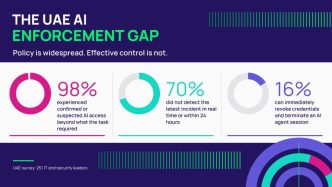
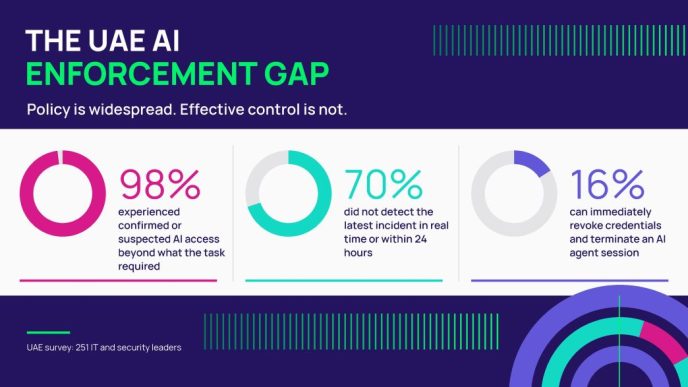
Recent research among senior technology and security leaders in UAE enterprises found that 52% already have AI agents deployed or in active development, yet only 10% consider themselves fully prepared to deploy agentic AI safely. At the same time, 98% of security teams surveyed had already encountered at least one real AI-related security risk in their environment.
The takeaway is not that organisations need to slow down their AI ambitions. It is that security, governance and resilience now need to move just as quickly.
Security needs to move upstream
Too often, cybersecurity enters the conversation after an AI deployment decision has already been made. The same UAE research found that only 15% of enterprises give the CISO mandatory approval authority over AI deployments, while just 10% define security requirements before evaluating an AI solution.
By the time security is asked to assess a deployment, the vendor may already be selected, data flows designed and integrations underway.
That approach worked poorly even in traditional IT environments. It becomes even harder to sustain when AI systems are capable of interacting with data, applications and other systems autonomously.
Security therefore needs to move from being a gate at the end of the process to being part of the decision from the beginning.
That means asking basic but consequential questions early: What data will this system access? What actions can it take? Who is accountable for those actions? What happens if its behaviour falls outside expectations?
AI agents make identity a governance issue
An AI agent is not simply another application. It can make decisions, perform tasks and interact continuously with enterprise systems. In practical terms, that makes every agent a form of non-human identity operating with a set of permissions.
That introduces a familiar cybersecurity issue in a much more complex form: access.
For decades, security teams have asked who should be able to access what. In an agentic environment, they must also ask what each AI agent should be able to do, under which conditions, and for how long.
The data suggests organisations are still working through this. More than half of UAE enterprises surveyed had already identified an agent acting beyond its intended authorisation, while 44% had not defined and enforced maximum permission boundaries for every agent role.
This is why agent security cannot be treated purely as a configuration exercise. Permissions, accountability and oversight are governance decisions with direct business consequences.
Resilience now has to account for AI failure
Cybersecurity also needs a broader definition of resilience. Traditionally, resilience planning has focused on events such as ransomware, outages or infrastructure compromise. In an AI-enabled organisation, another category needs to be considered: what happens when an autonomous system behaves unexpectedly?
That does not necessarily mean malicious compromise. An agent may operate outside its intended boundaries, make an irreversible decision, or lose access to a third-party service on which a critical process depends.
Yet only 43% of organisations surveyed had documented an AI agent taking an unauthorised or irreversible action at scale within their business continuity and disaster recovery planning.
Resilience therefore has to evolve from simply preventing incidents to ensuring organisations can contain harm, maintain critical operations and recover when AI systems fail or behave in ways that were not anticipated.
Defenders will also need AI
AI is not only expanding the attack surface. It is also becoming essential to how organisations defend themselves.
Globally, the time between vulnerability discovery and exploitation is shrinking, while security teams are managing more signals and intelligence than they can realistically process manually. The response cannot simply be more alerts. Defenders need AI to help identify exposure, connect signals, prioritise risk and act faster.
In the UAE, that shift is already underway. Recent research found that 66% of security leaders surveyed are already using AI for cybersecurity purposes, with the remainder planning to do so within the next 12 months.
The strongest organisations will therefore do three things at once: strengthen the fundamentals, secure AI from the outset, and use AI to improve how they defend.
For the UAE, the opportunity now is to set the standard for secure AI at scale. That means bringing security into decisions earlier, extending identity and permission controls to AI agents, and building resilience for a more autonomous digital environment.
AI and cybersecurity can no longer be treated as separate conversations. Security now has to be designed into the transformation itself.