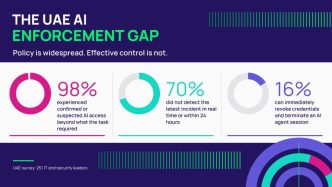

- All UAE respondents reported having a formal policy governing AI data access, but only 59% said it was actively enforced.
- Seven in ten organisations failed to detect the latest instance of excessive AI access in real time or within 24 hours.
- Only 16% said they could immediately revoke an AI tool’s credentials and terminate its session.
The company’s 2026 Identity Security Report: The AI Enforcement Gap found that 98% of 251 surveyed IT and security leaders in the UAE reported confirmed or suspected instances of AI tools accessing sensitive data beyond what their tasks required. This compared with 87% of respondents across the seven countries surveyed.
Although every UAE respondent said their organisation had a formal policy governing the data AI tools and agents could access, only 59% said the policy was actively enforced, against 71% across the overall sample.
Detection and response were also areas of concern. Seven in ten UAE respondents said their organisation had failed to detect its latest instance of excessive AI access in real time or within 24 hours. Across all respondents, the figure was six in ten.
The findings also highlighted gaps in accountability and emergency response. While 98% of UAE respondents said approval from a named individual was required at least sometimes before an AI tool could access a new sensitive data source, only 35% said they could always trace a sensitive access event back to a named human authoriser.
Furthermore, just 16% said their organisation could immediately revoke an AI tool’s credentials and terminate its session, compared with 35% across the full survey.
Commercial pressures may contribute to the enforcement gap. According to Delinea, 41% of UAE respondents said their organisation either allowed employees to work around AI governance processes without formal approval when deadlines or business demands required it, or granted temporary access and reviewed it later.
“Written policy is only as good as an organisation’s ability to enforce it at the moment an AI agent acts,” said Art Gilliland, CEO of Delinea. “The UAE has clearly recognised the need to govern AI access, but the findings reveal what I call the fallacy of policy: assuming that defining what an agent should be allowed to do is the same as controlling what it actually does. That distinction becomes critical when agents operate across systems and make decisions at machine speed.”
The research was conducted by Censuswide among 2,004 IT and security leaders at organisations with at least 500 employees that were using or piloting AI in Australia, Germany, India, Singapore, the UAE, the UK and the US. The UAE findings were based on 251 respondents.