

Written by Crownox.
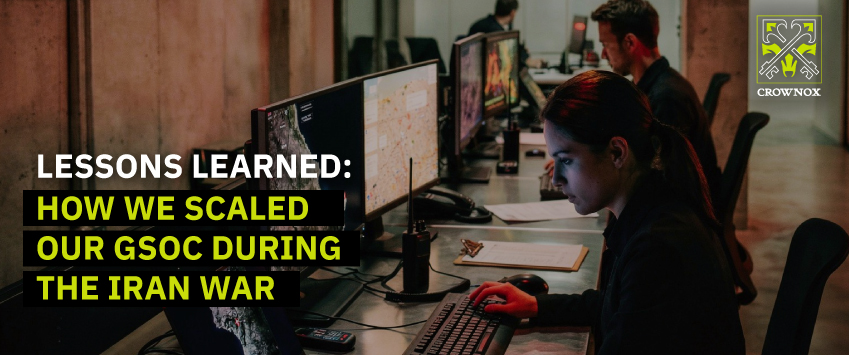
When the US-Israeli war on Iran escalated into a full-scale regional war, our Global Security Operations Center (GSOC) transitioned from steady-state monitoring to crisis-level operations within 48 hours. What had previously been a stable security monitoring function rapidly evolved into a high-tempo crisis response operation. Client inquiries surged, evacuation coordination requests increased sharply, and demand for real-time intelligence and decision support exceeded normal operating capacity by several multiples.
Like many organisations, our standard operating procedures were not designed for this operational tempo. It quickly became evident that maintaining continuity required more than increased effort; it required a fundamental shift in decision-making processes, team structure, and supporting systems.
The following are four principal lessons learned from scaling a GSOC under extreme operational pressure.
1. Decision-Making Must Be Decentralised During Crisis
Under normal operating conditions, centralised decision-making promotes consistency, accountability, and oversight. In a rapidly evolving conflict environment, however, it can become a critical bottleneck.
One of the first operational adjustments implemented was the introduction of pre-authorised decision thresholds. This empowered GSOC personnel to make time-sensitive operational decisions, particularly during overnight shifts and periods of elevated tempo, without requiring senior-level approval.
This structural change significantly reduced response times. Equally important, it increased operational confidence across the team. Analysts and operators were given clear authority parameters, enabling them to act decisively when circumstances demanded immediate action.
2. When Properly Prepared, Regional Teams Function as Critical Force Multipliers
No GSOC should operate as an island.
As operational demand increased, we activated regional offices to support core GSOC functions. While not originally designed as primary crisis operators, accelerated cross-training and clearly defined responsibilities enabled these teams to function as an immediate extension of operational capacity.
This distributed workload across multiple time zones and reduced pressure on the central GSOC. More importantly, it introduced operational redundancy: when one location became overwhelmed, another could assume critical responsibilities without interruption.
Secondary support teams should not be treated as contingency assets alone; they must be deliberately integrated into resilience planning and trained before a crisis emerges.
3. Staffing Models Must Be Designed for Rapid Expansion
Many organisations approach staffing as a fixed construct: a predetermined number of analysts, standard shift rotations, and limited surge capacity. This model is insufficient under wartime conditions.
To meet escalating demand, we required a framework capable of scaling personnel rapidly without compromising operational quality. This involved identifying surge roles in advance, establishing reserve staffing pools, and simplifying key workflows so newly integrated personnel could contribute effectively with minimal delay.
True scalability depends on designing systems into which personnel can be integrated quickly and perform effectively from the outset.
4. Communication Redundancy Is a Core Operational Requirement
One of the most important lessons emerged from an unexpected system failure: at the peak of the crisis, WhatsApp—our primary client communication platform—became operationally ineffective. The volume of outbound messaging triggered spam controls, temporarily blocking our ability to communicate with clients precisely when uninterrupted connectivity was most essential.
This failure underscored an important reality: consumer-grade communication tools, while useful, are not designed for sustained crisis-level operational demand.
In response, we immediately transitioned to alternative previously tested communication platforms to restore reliable connectivity.
Since that experience, communication fallback mechanisms have become a formal operational requirement. If one platform fails, an alternative must be immediately available.
The Broader Lesson: Adaptability Is the Foundation of Resilience
A common misconception is that resilience is defined primarily by robust plans and established systems. While those are necessary, they are not sufficient. True resilience is the ability to adapt when established plans no longer apply.
Our operational success during this war did not result from rigid adherence to existing procedures. Rather, it stemmed from our ability to recognise that those procedures no longer matched the realities of the threat environment and adjust in real time.
We restructured decision authority, expanded staffing models, integrated regional teams, and rebuilt communications pathways while operations were still underway.
Conclusion
The true test emerges when demand surges, information is incomplete, and decision windows contract from hours to minutes.
In such environments, resilience is determined less by tools and more by how decision authority, structure, and information flow are designed under pressure.
GSOCs that cannot scale, decentralise, and adapt struggle under sustained operational pressure, regardless of technological capability.
Those that do become force multipliers for the wider organisation, sustaining continuity and decision advantage during moments of highest consequence.


